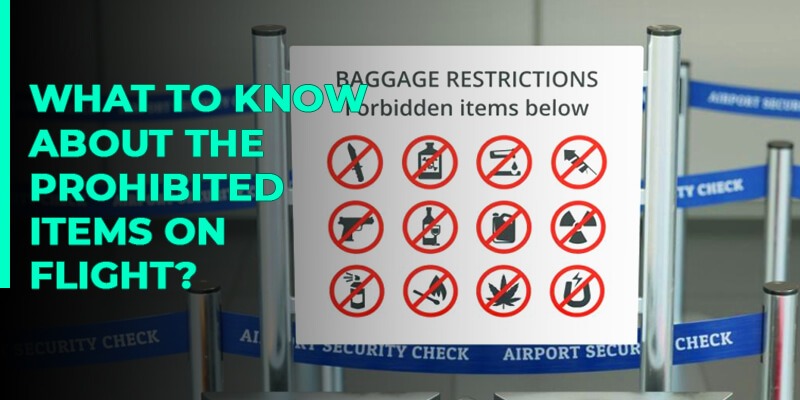
International Travel Standards prohibit carrying certain items on board to ensure safety. Airport authorities strictly prohibit any kind of weapons, flammable substances, explosives, and similar items on flights. Any spillable toxic chemicals, sharp objects, weapons, explosives, or flammable substances can disrupt a plane’s environment and can even create a hazardous situation.
To prevent security threats and maintain a safe cabin environment, the International Travel Standards have prepared guidelines and a list of prohibited items for flights. Everyone must follow the list and guidelines to ensure they aren't carrying anything illegal or likely to cause trouble. But how will you know about the prohibited items in flight? The blog covers “which items are not allowed in flight” and tips for handling electronic devices safely.
What Prohibited Items on Flights Should I Avoid?
International Travel Standards, such as IATA, have established guidelines for transporting hazardous materials on aircraft. Every passenger must follow these guidelines to ensure their bags clear security and they can board the plane. Here’s what a traveler should avoid:
Weapons and Objects with Sharp and Pointy Edges
- Hatches, axes, darts, arrows, or other iron objects with spikes or sharp sides.
- Knives, blades, razors, ice picks, and other metals.
- Scissors, scalpels, meat cleavers, box cutters, swordsticks, etc.
- Tools like pliers, hammers, drills, screwdrivers, crowbars, wrenches, etc.
Blunt Objects
- Baseball and softball
- Hockey sticks, Snooker cue sticks, and lacrosse sticks
- Canoe or kayak paddles
- Skateboards
- Fishing rods
- Knuckle dusters, clubs, rice flails, nunchucks, coshes, kubatons, kubasaunts, and other martial arts equipment.
Devices & Spare Batteries
- Always carry lithium or lithium-ion batteries for phones, laptops, cameras, and other electronic devices in carry-on bags.
- International Travel Standards allow you to carry battery-operated devices onto the aircraft for personal use.
- The devices’ batteries must include the Wh (Watt-hour) rating and should range from 100Wh to 160Wh.
- You must keep power banks and spare batteries for portable electronic devices in carry-on bags only.
- Spare batteries must be within the permissible Wh limit when carried in carry-on or checked baggage. A few things to ensure are:
- Travelers can keep up to 5 batteries without the airline's approval if they are 100 Wh or less. If carrying more than 5 batteries, you must get the airline’s approval.
- Travelers may be allowed to carry up to 2 spare batteries, each between 100Wh and 160Wh, in their carry-on bags only. But first, the traveler must get the airline’s approval.
- Batteries with more than 160 Wh of power are strictly prohibited on flights.
Caution! Electronic Devices Must Be Handled Carefully.
Electronic items might not be prohibited items on flights, but they must be handled carefully. If you are carrying any electronics, make sure you keep them to yourself. Do not throw them anywhere. Handle them properly, as electronics are prone to damage and can cause chaos. The following are some electronic devices that must be handled carefully:
- Power banks and Lithium-ion batteries that are separated from a device.
- E-cigarettes or Vape
Take care of the following things:
- Keep the original retail packaging on when carrying batteries to prevent short circuits.
- Pack electronic devices with lithium-ion batteries in a sealed plastic bag or an insulated pouch to prevent a leak.
- Get clearance approval from the check-in counter if you are carrying batteries with a capacity of 100Wh to 160Wh.
- Keep your cabin baggage in the overhead compartment when carrying spare batteries, power banks, e-cigarettes, and other items.
- Make sure to switch off all the electronic devices before putting inside the carry-on bags and in the overhead compartment.
- Do not let the spare batteries, power banks, and vapes sit in your carry-on bags. Keep them to yourself in your front seat pocket.
- If your power bank or batteries show any sign of overheating or swelling, you must inform the crew immediately.
- Do not use any idle charging device on board.
- Never keep your power banks, e-cigarettes, and spare batteries in checked bags.
Electronics that Don’t Belong in Checked Luggage
You may keep spare lithium metal or lithium-ion batteries, or other portable electronic devices containing them, in your checked luggage. However, battery-operated power vehicles, e-cigarettes, mobility devices, and the rest do not belong in checked baggage.
Carry any battery-operated mobility device, such as a wheelchair, in checked baggage only after preparing the battery in accordance with the guidelines. You must check the International Travel Standards for carrying electric wheelchairs.
Prohibited Items in Checked Baggage and Carry-on Bags
There are certain prohibited items on airplanes that violate International Travel Standards. Carrying them in either carry-on bags or checked luggage is a punishable offence. You must not bring these items with you on a flight under any circumstances. The following are some strictly prohibited items on flights:
Weapons, Guns, & Firearms
Weapons, guns, and firearms are some strictly prohibited items on flights. You cannot bring them under any circumstances as they promote violence and danger. Below is a list of prohibited items in flight:
- Sharp metals: Knives, scissors, blades, box cutters, and tools.
- Firearms: Pistols, signal flare pistols, all kinds of toy guns, crossbows, spear guns, ball bearing guns, pellet guns, lighters or other objects shaped like a firearm, and the rest.
- Any components or parts of firearms.
- Cattle prods or other stun guns.
Flammable Substances or Explosives
The following are some prohibited items on planes:
- All kinds of grenades
- Gas containers (Example: Propane, butane, acetylene, massive quantities of oxygen, etc.).
- Any form of flares and other pyrotechnics.
- Fireworks, including party poppers and toy caps.
- Non-safety matches
- Ammunition, detonators, fuses, blasting caps, and other explosives.
- Smoke-generating canisters or cartridges.
- Gasoline, diesel, petrol, or any kind of flammable liquid fuel.
- Lighter fluid, paint thinner, aerosol, spray paints, and turpentine.
- Alcohol or alcoholic beverages.
- Ethanol or vehicle fuel system components containing internal combustion engines.
- MREs (Meal Ready to Eat), self-heating meals, or FRH (Flameless Ration Heater).
Chemicals or Toxic Substances
The following kinds of chemicals or toxic substances are considered airport prohibited items:
- Any corrosive substances
- Acids
- Alkalis (Example: Spillable wet batteries)
- Bleaching substances, like mercury and chlorine.
- Disabling or incapacitating sprays, such as pepper spray, tear gas, mace, or any radioactive material.
- Biological hazardous materials
- Infectious substances such as infected blood, viruses, and bacteria.
Living Botanicals
Living botanicals, such as roots, flowers, bark, and the rest of the parts of a plant, soil, seeds, etc., are strictly prohibited items on flights. Airport security cannot allow you to carry them in either your checked or carry-on bags.
Whether you are carrying any potted plants or taking elements such as seeds, roots, soil, or other materials, you must obtain a Phytosanitary Certificate from the Ministry of Agriculture. These items must be transported as cargo. So make transportation arrangements accordingly.
Conclusion
In conclusion, the airport security rules are quite strict for prohibited items on flights to ensure everyone’s safety. You are responsible for complying with the rules and must avoid packing any unauthorised or non-permitted items at the airport. Avoid carrying any sharp objects, lithium-ion batteries, liquids, aerosols, chemicals, etc.
If airport security detects that you are in possession of any of these items, they can stop you at the security gates. You may also miss your flight due to additional security screening. If you're unsure about carrying an item, avoid packing it or check the regulations to save time at the airport.